
What good habitats look like
What we want to see and hear
Nature thrives on diversity. This is true for all habitats. Any habitat that appears to be uniform in form or colour throughout the season is likely to be poor for nature and biodiversity. All habitats should have a sound scape. A meadow in the spring and summer should have bird song and crickets buzzing. A woodland should be alive with birdsong. A water course should have bird and insect sounds. If a habitat is silent, it is probably not thriving. Somewhere in between will have good potential for improvement!
Connectivity between habitats is really important wherever possible, so similar habitats are next to each other, or nearby, creating ‘islands’ for more mobile species to move between.
Grasslands
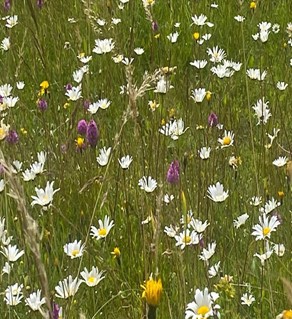
Diverse structure and colour and sound.
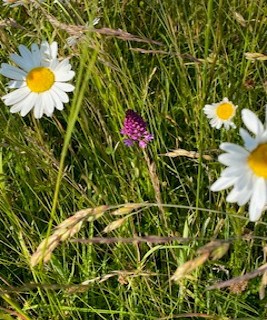
Grasses should be varied in species, some small and fine, varying to tall and robust. The finer ones are preferable because they don’t dominate other species. The height of the grasses should be varied, creating a mixed structure within the sward. Some tussocky development is good. If areas are cut for hay, it is preferable to leave significant margins uncut around the field edges (or even swathes through the middle of the field) as a refuge for insects and small mammals. It is best to cut grass at the beginning and / or end of the season and to leave it growing between April and August or September. When it is cut, the cuttings (‘arisings’) should be removed so they don’t add too many nutrients to the soil, lower nutrient levels are better for developing diverse grassland.
It is ideal to allow some areas of the grassland to set seed, and for this to be left in situ. This provides a food source and refuge for insects, small mammals and birds.
A variety of colour within the grassland is good. (If any habitat is a single colour throughout the season, it probably means that it lacks diversity). Within the grasses a good mix of wildflowers should proliferate. Native wild meadow flowers thrive in grasslands with the finer grasses. This is because the heavier, coarser grasses dominate the sward and don’t allow the flowers to gain traction. Our native wildflowers need a more open sward to enable them to get through. This is aided with the addition to the sward, of plants such as yellow rattle. Yellow Rattle is semi parasitic on grasses, so if it is in the sward, it reduces the vigour of the grasses, allowing the flowers to get through, so it can help increase diversity, but it may also need to be managed over time.
Trees and woodlands
Ideally native trees of varying ages. There is a tendency to find plantation woodlands have a very uniform age structure, which then means that many of the trees will reach their natural maturity at a similar time. Succession planning in relation to woodland management is important to create the age structure, thus creating a varied age range and form. A mixture of species that flower and fruit throughout the year provide a healthy habitat for wildlife to thrive. There should be a healthy mixed shrub understory creating a gradation of structure from the ground up to the mature tree canopy. This shrub understorey should again be varied in species and structure. A patchwork of light, shade and form should be created for woodland inhabitants.
It is good to have glades within the woodland. These can be either along ride side, or within the woodland itself, creating habitat corridors for woodland species. These glades provide sheltered, open spots for woodland butterflies and insects and create good gradation of vegetation from ground to canopy. The glades also provide spots for woodland flowers to develop.
Dead wood should be left in situ. This can be ‘standing’ or in habitat piles. It provides a very important habitat for beetles and other small insects and their larvae. It can also provide shelter for reptiles and hedgehogs.
Individual trees provide a variety of habitats for numerous species, giving roost sites, food and shelter. There should be some planning and planting of young trees to enable succession to occur without leaving a gap. The ground around the base of the tree (to the drip line) should, ideally, be left unmown and uncultivated. This allows a healthy, active fungal association to develop around the root system. If safe to leave dead wood in the tree, that is recommended, however, if in a public place safety would have to be assessed.
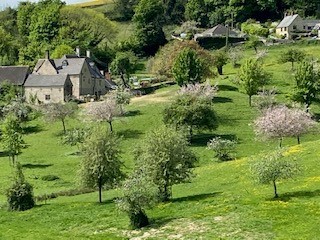
Orchards provide a varied habitat for numerous species, from birds to beetles. Old trees with cavities provide nest sites for birds and shelter for roosting bats.
https://www.woodlandtrust.org.uk/
https://assets.publishing.service.gov.uk/media/5b35fa57ed915d0b53021ae1/FCPG201.pdf
Hedgerows
Mixed native species, aiming to be a minimum of 2m in height. If trimmed, it should Ideally be an “A” shape with a minimum of 2m width at the bottom. Trimming each side on alternate cutting years and ideally any hedge cutting/trimming only takes place once every 3 years at the most (unless required for safety). This will allow more fruit and flowers to develop. The fruiting bodies develop on the previous years growth, so if that is cut, the potential to produce flowers and seeds is removed. If hedges are to be laid, this is normally done every 7 to 10 years (during the winter), depending upon rates of growth. An uncut margin on both sides of the hedge will add to the biodiversity and refuge areas for animals living in or moving along the hedgerow. Standard trees can be included at intervals along the hedge line.
Mixed scrub
Mixed scrub is most often areas of thorn and bramble, amongst grassland. This open mosaic of vegetation provides a varied and valuable habitat for a multitude of species. It is best managed using grazing animals, which nibble the more robust species such as bramble and thorn. Across such areas should be seen a wide variety of structure, height and form. It is good to have species that produce fruiting bodies, such as Hawthorne and Dog Rose, providing a food source through the winter for birds and small mammals. Dense scrub - where the shrubs and bushes form impenetrable barriers to humans and livestock - provide food and shelter for wild fauna.
Springs and streams
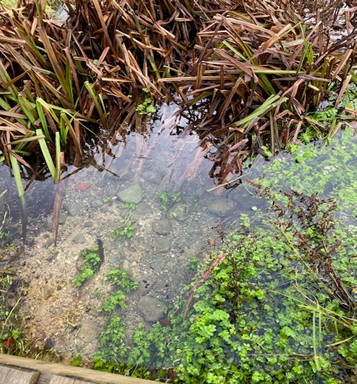
A natural spring issues from the ground and creates a small area of wetland or a “flush”, often with distinctive vegetation such as rushes or sedges associated with wetter areas. Spring water should be crystal clear and odourless. A naturalised spring is not always within a channel and, where land use allows, should be “spreading” out from the place the spring issues.
A natural stream should have a variety of deeper areas and shallow riffles and have multiple changes of direction of flows, both within the channel (sinuosity) and along the channel itself (meanders). The top of the water should be level with the bank (so high flows can move out of the channel), and there should be no de-silting or dredging to make the channel deeper. (Many streams have been made into ditches by being made straighter and deeper).
You should be able to hear the water, which indicates this variety of flows. SDC produced a comic about the sound of water called “The Sound of a River”. You can read it and access it here: https://nbscomics.com/2023/05/30/2023-sound-of-a-river/
On the bankside – there should be little or minimal visible erosion caused by livestock. Livestock should be kept out of streams and provided with alternative drinking sources. A small amount of poaching (damaging, creating holes within the grassland by animals’ feet) can create additional habitat, but if this results in runoff of sediment into the water course damage to the stream bed will occur. The banks should be natural in material and form with little or no manmade concrete or pipes or other physical intrusions into the water course.
Water clarity and stream bed – water should be crystal clear and odourless with the base of the stream bed visible. The bed should have a mixture of stones and gravel. Some small areas of silt or mud are ok, but not if this covers the whole stream bed. (not covered in silt).
Vegetation - there should be mixed streamside vegetation – trees and bushes should be present (Alder and hazel are both common streamside trees in Stroud District) and varied along the stream line, with diverse structure and colour.
Soils and fungi
Health soils smell pleasant. It is often described as earthy and fresh, reminiscent of a forest floor after rain. This pleasant aroma is due to the presence of beneficial microbes, particularly beneficial bacteria. crucial for decomposing organic matter. Healthy soil is an active, living system that supports robust plant growth and sustainable agriculture.
Depending upon what rock substrate the soils have, healthy soil is often characterised by a rich, dark brown or black colour, indicating high organic matter content. The depth of this layer will vary depending upon the topography and soil type. The soil should have a crumbly texture, which allows for good aeration and water retention, essential for plant roots to penetrate and thrive. Healthy soil will have plenty of life within it, from earthworms to tiny microorganisms, all contributing to a balanced ecosystem.
Healthy soil is the home to vast number of fungal mycelia, most of which cannot be easily seen. This is the root of life, without which our ecosystems would cease to function.
Traditional Orchards
An old, well-established orchard is home to a diverse ecosystem. Old (veteran) trees should be maintained and left in situ, (unless infected with disease such as honey fungus), with features like rot holes, split bark, and hollow trunks, which provide habitats for various fungi, invertebrates, birds and small mammals. Beneficial insects like bees and ladybirds are common, aiding in pollination and pest control. Good succession planning, the planting of new young trees, is vital to keep the continuity of habitat through the years. The species should be varied, often containing apples, pears, nuts and plums in one orchard. Older orchards may contain important local heritage varieties of fruit trees. Mistletoe is often found in fruit trees. The spring blossoms attract insects and birds to the site, creating a buzzing sound of life.
The trees should be well-spaced, allowing for ample sunlight and air circulation, which helps prevent disease and allows for a diverse understorey of grasses and wildflowers to develop. This is often grazed by livestock or cut for hay, which helps maintain the health of the soil and the orchard ecosystem.
Formative pruning for the young trees helps develop an open shaped branch structure, which allows good air circulation and minimises the potential for infection occurring due to branches rubbing on each other. Once established the trees would benefit from periodic management pruning, to ensure any damage or disease is dealt with. Orchard trees can be long-lived and managed without chemical intervention, resulting in a landscape that supports a wide range of wildlife.
The presence of log piles or dead wood heaps further enhances the habitat, offering shelter for creatures like frogs, toads, beetles, and hedgehogs. Overall, a traditional orchard is not just a place for fruit production but a vibrant ecosystem that plays a crucial role in local biodiversity and heritage.
Habitat Banks
A habitat bank is an area of land that is managed to create, enhance and maintain habitats for wildlife. To learn more about habitat banks, how they work and the opportunities they provide, visit our dedicated Habitat Banks page.